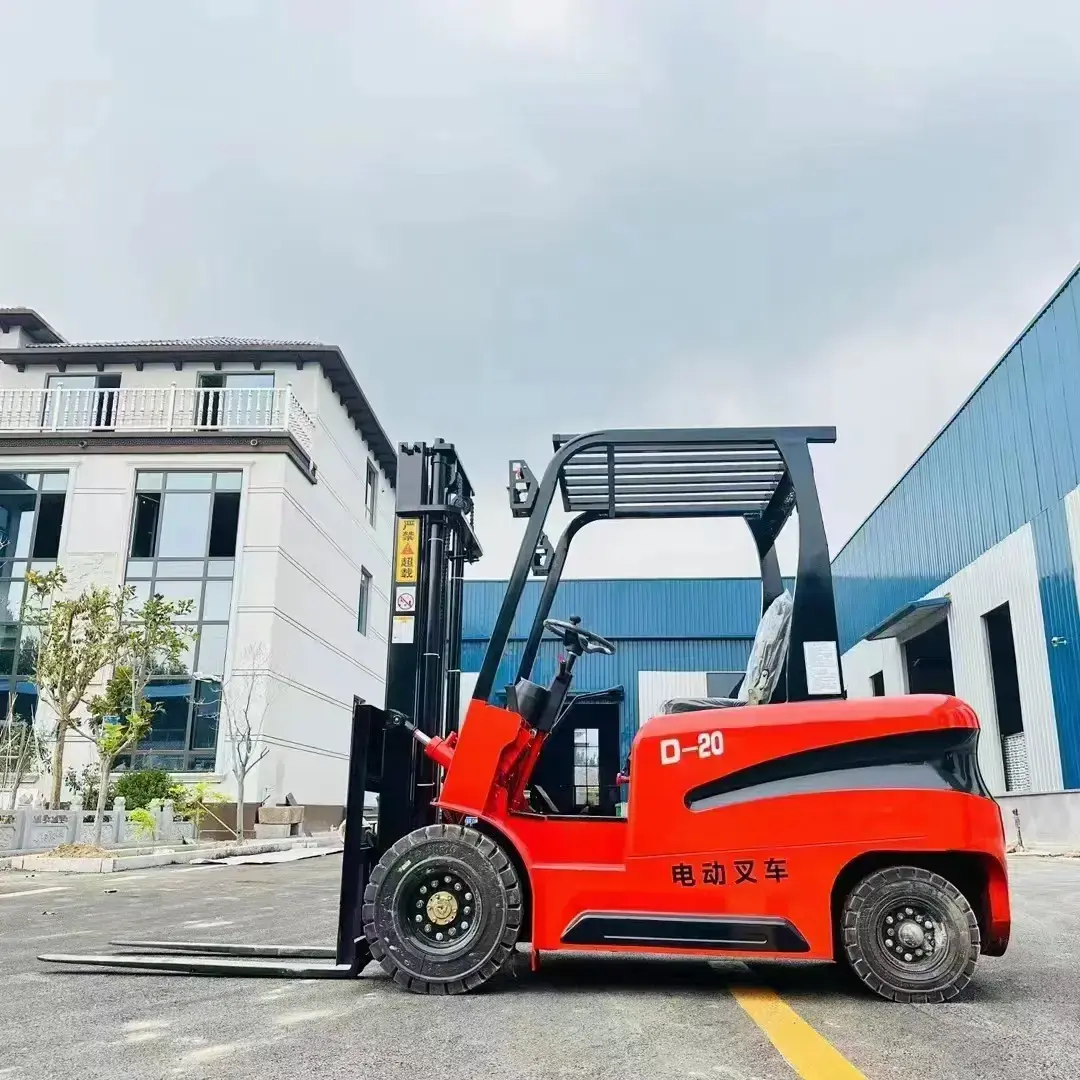
Why 2 Ton Electric Forklifts Are a Standard Choice in the US & Europe
A 2 ton electric forklift is one of the most commonly selected models among US importers and EU distributors because it offers an ideal balance between lifting capacity, operational efficiency, equipment cost, and maneuverability.
In North American and European warehouse environments, 2 ton forklifts are widely used for pallet handling, racking operations, retail distribution, and third-party logistics (3PL). Compared to heavier forklifts, a 2 ton model typically delivers lower acquisition cost, lower energy consumption, and easier daily handling, making it a cost-effective standard fleet unit.

What Does “2 Ton Capacity” Really Mean?
Rated capacity does not simply represent maximum lifting weight — it depends on load center, lift height, mast configuration, and real working conditions.
Key Factors That Affect True Capacity
- Load center distance — longer pallets reduce effective capacity
- Lift height — higher lifting reduces stability margin
- Mast type — duplex vs triplex affects load performance
- Attachments — side shifter or clamp changes real lifting ability
Buyer insight: Many procurement mistakes happen when buyers select forklifts based only on the “2 ton” label without confirming actual load center and stacking height.
Recommended Lift Heights for Warehouse Applications
Choosing the correct lift height affects racking efficiency, operator visibility, stability, and total cost.
Common Options in the US & Europe
- 3 m — Standard pallet racking and container loading
- 4.5 m — Medium-height storage warehouses
- 6 m — High-rack logistics and dense storage operations
Mast Configuration Considerations
- Duplex mast — cost-effective for general warehousing
- Triplex mast — better for high stacking and low overhead clearance
- Full free lift — recommended when working inside containers
Battery Selection: Lead-Acid vs Lithium for 2 Ton Forklifts
Battery choice significantly impacts operating cost, charging behavior, uptime, and maintenance workload.
Lead-Acid Battery — Budget-Friendly Option
Best suited for:
- Single-shift operations
- Facilities with fixed overnight charging schedules
- Buyers prioritizing lower upfront investment
Considerations:
- Requires regular watering
- Needs dedicated charging time
- Battery performance declines if charging discipline is poor
Lithium-Ion Battery — High-Uptime Option
Best suited for:
- Multi-shift warehouses
- High-throughput logistics centers
- Buyers prioritizing lower downtime and long-term ROI
Advantages:
- Fast opportunity charging
- No watering or acid maintenance
- Longer lifecycle vs lead-acid
- Stable power output throughout the shift
ROI insight: For fleets running more than 6 hours per day, lithium forklifts often deliver lower total cost of ownership despite higher upfront price.
Tire Selection and Floor Conditions
Tire type should match warehouse flooring, outdoor exposure, and load profile.
Common Tire Options
- Cushion (PU) — smooth indoor floors, quiet, low rolling resistance
- Solid rubber — mixed indoor/outdoor use
- Pneumatic — uneven ground, yard operations, ramps
If your warehouse includes ramps, dock plates, or uneven concrete, tire choice directly affects traction, braking performance, and operator safety.
Safety Features That Reduce Business Risk
Safety is not only a regulatory requirement — it also reduces accident cost, insurance claims, downtime, and liability exposure.
Recommended Safety Features
- Operator presence system
- Seat belt and emergency cut-off
- Speed limit by zone
- Blue safety light / pedestrian warning light
- Reversing alarm
- Optional camera for high stacking
Business impact: Investing in safety features often reduces hidden operational costs over the forklift’s lifetime.
Real-World Use Cases for 2 Ton Electric Forklifts
A 2 ton electric forklift is widely used across:
Warehousing & Logistics
- Palletized goods
- E-commerce fulfillment
- Retail distribution centers
Manufacturing
- Assembly line material handling
- Component transport
- Packaging operations
3PL & Distribution
- Multi-client warehouses
- Seasonal peak operations
- Mixed SKU handling
Common Buying Mistakes to Avoid
Avoid these frequent procurement errors:
- Over-specifying capacity — increases cost without adding value
- Ignoring aisle width — results in poor maneuverability
- Wrong charger voltage — mismatch between US/EU standards
- Underestimating battery requirements — causes downtime
- Skipping spare parts planning — increases long-term service risk
OEM Customization & Bulk Supply for US and EU Buyers
For distributors and fleet buyers, working with an OEM-capable manufacturer provides competitive advantages:
OEM Options
- Custom color and branding
- Private label nameplate
- Packaging customization
- Local-language manuals
- Dealer marketing material support
Supply & Delivery Capability
- Bulk production for distributors
- Export-ready packaging
- Pre-shipment inspection support
- Spare parts kits and long-term service planning
How to Get an Accurate Quote Faster
To receive a precise quotation, prepare the following information:
- Required load capacity
- Lift height and mast type
- Battery type preference
- Aisle width and warehouse layout
- Usage environment (indoor/outdoor)
- Destination port in the US or Europe
Providing this data helps suppliers deliver faster, more accurate, and better-configured proposals.
Work With a Manufacturer Serving the US & Europe
If you are sourcing forklifts for the United States or Europe, choosing a supplier with OEM capability, stable production capacity, and export experience can significantly reduce procurement risk.
We support OEM branding, distributor partnerships, bulk orders, spare parts programs, and export-ready packaging. Our engineering team can recommend a 2 ton electric forklift configuration optimized for your application, budget, and long-term operating cost goals.
📩 Contact us for technical consultation and OEM pricing
Email: contact@jinli-machinery.com
WhatsApp: +86 18522164600