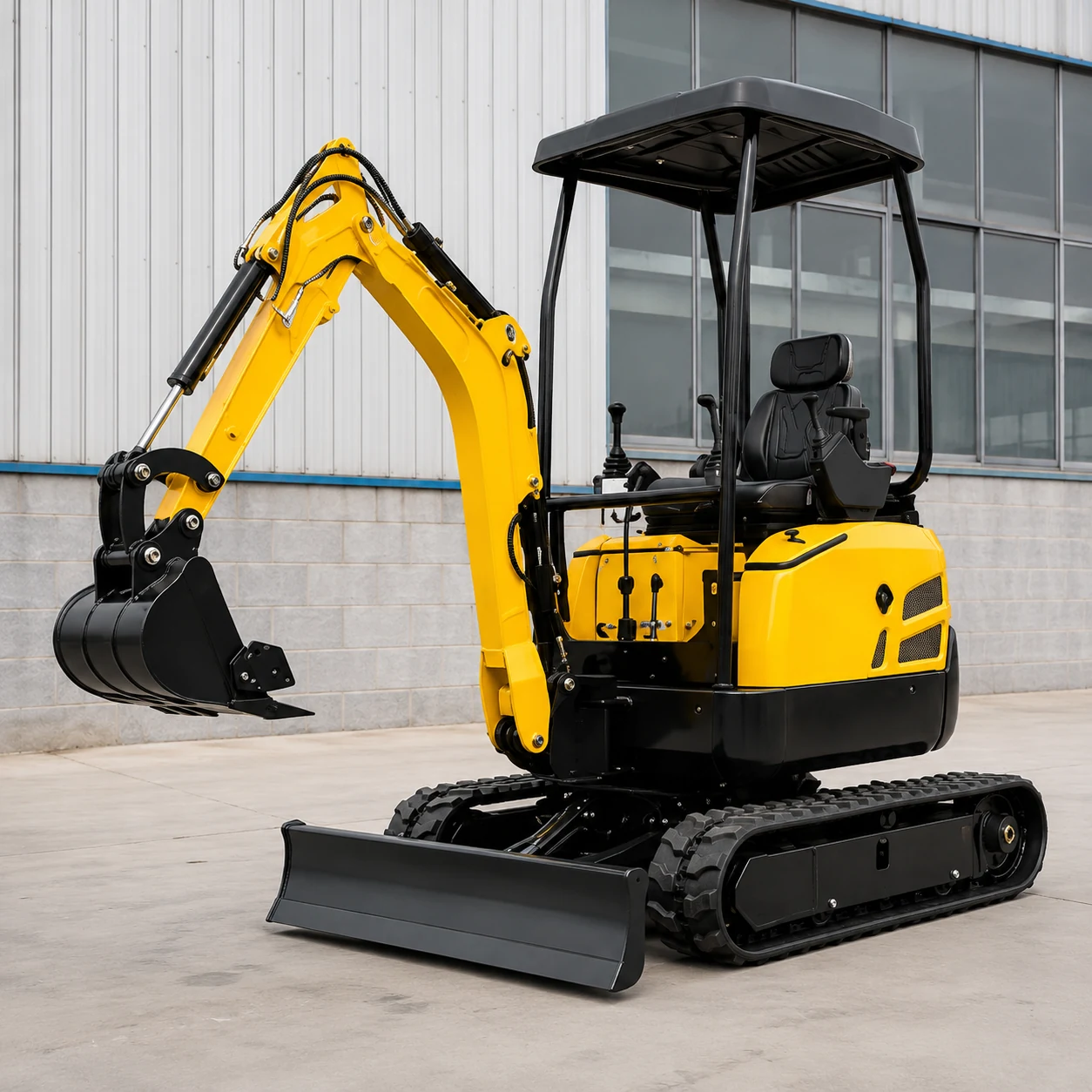
1 Ton vs 2 Ton Mini Excavator: Making the Right Investment for Your Business
For landscaping businesses, independent plumbing contractors, and rental fleet managers, deciding between a 1-ton (micro) and a 2-ton (compact) excavator is a critical business decision.
On the surface, the visual difference might seem minor. However, that extra ton of operating weight drastically changes the machine's breakout force, hydraulic capacity, transport logistics, and ultimately, your return on investment (ROI). Choosing a machine that is too small means struggling through tough soil and wasting man-hours; choosing one that is too large means damaging customer properties and limiting your access to tight residential job sites.
In this ultimate guide, the Jinli Engineering Team breaks down the hard numbers and real-world applications to help you choose the exact machine size your business needs.
Core Performance & Specification Breakdown
Before diving into applications, let's look at the baseline engineering differences between the two weight classes. We have broken down the critical specs you need to consider.
1-Ton Class (Micro Excavator) Specifications
- Operating Weight: 1,800 - 2,500 lbs (800 - 1,150 kg)
- Max Digging Depth: Approximately 5.0 - 6.0 ft (1.5 - 1.8 m)
- Engine Horsepower: 10 - 15 HP
- Track Width (Stance): Retractable design, typically narrowing down from 39 inches to 28 inches.
- Bucket Breakout Force: Around 2,000 - 2,500 lbf
- Auxiliary Hydraulic Flow: 4 - 6 GPM (Gallons Per Minute)
2-Ton Class (Compact Excavator) Specifications
- Operating Weight: 3,800 - 4,500 lbs (1,700 - 2,050 kg)
- Max Digging Depth: Approximately 7.5 - 8.5 ft (2.3 - 2.6 m)
- Engine Horsepower: 18 - 25 HP
- Track Width (Stance): Fixed or Retractable, typically ranging from 39 to 51 inches for maximum stability.
- Bucket Breakout Force: Around 4,000 - 5,000 lbf
- Auxiliary Hydraulic Flow: 7 - 12 GPM (Gallons Per Minute)
The 1-Ton Micro Excavator: The King of Confined Spaces
The 1-ton excavator is engineered for one primary purpose: access. If a wheelbarrow and a shovel can get there, a 1-ton excavator can likely get there too, but it will do the work ten times faster.
Key Advantages of the 1-Ton Class
- Zero-Access Entry: The defining feature of most 1-ton machines is the retractable undercarriage. By pulling a lever, the tracks shrink inward, allowing the machine to drive through standard 36-inch backyard gates or even inside residential homes for basement excavations.
- Minimal Ground Disturbance: With an operating weight under 2,500 lbs, these machines exert incredibly low ground pressure. You can drive them across established lawns or delicate paving stones with minimal risk of turf damage.
- Ease of Transport: You do not need a heavy-duty truck. A 1-ton machine can be easily towed on a single-axle utility trailer behind a standard half-ton pickup (like an F-150) or even a large SUV.
Ideal Applications for 1-Ton Machines
- Indoor Demolition: Breaking up basement concrete floors or digging out crawl spaces.
- Residential Plumbing & Irrigation: Trenching for sprinkler systems or repairing broken water lines in established, fenced-in backyards.
- Light Landscaping: Planting trees, removing small stumps, and grading topsoil in tight property lines.
The Main Limitation: The main drawback is breakout force. A 1-ton machine will struggle in heavy clay, rocky soil, or when trying to rip out large, established tree roots. Its lower hydraulic flow also limits the size of the attachments it can run.
The 2-Ton Mini Excavator: The Versatile Workhorse
The 2-ton class is widely considered the "sweet spot" of the compact equipment industry. It bridges the gap between ultra-compact access and serious earthmoving power.
Key Advantages of the 2-Ton Class
- Superior Digging Power: With double the breakout force of a micro machine, a 2-ton excavator can easily chew through compacted clay, frozen ground, and rocky terrain that would stop a 1-ton dead in its tracks.
- Greater Lifting Capacity: Stability is a major factor. The wider stance and heavier counterweight allow a 2-ton machine to safely lift heavy materials, such as large retaining wall blocks, concrete pipes, or heavy root balls, without tipping over.
- Robust Hydraulic Attachments: The higher auxiliary hydraulic flow (often exceeding 10 GPM) means a 2-ton machine can effectively run demanding attachments like hydraulic breakers (hammers) for concrete demolition, heavy-duty brush cutters, and large augers for fence posts.
Ideal Applications for 2-Ton Machines
- Foundation & Footing Work: Digging footings for home additions, garages, or large decks.
- Utility Trenching: Digging deep trenches (up to 8 feet) for sewer lines, electrical conduits, or municipal water mains.
- Heavy Landscaping & Hardscaping: Building large retaining walls, clearing heavy brush, and preparing driveways for paving.
The Main Limitation: You lose the "zero-access" capability. A 2-ton machine will not fit through a standard pedestrian gate, and its heavier weight requires a heavy-duty dual-axle trailer and at least a 3/4-ton towing vehicle.
Transport and Logistics: US vs. EU Regulations
When factoring the true cost of ownership, you must consider how you will move the machine from job site to job site.
United States Towing Regulations
Transporting a 1-ton machine is incredibly cheap and accessible. Any standard contractor setup will work. For a 2-ton machine, you are stepping into a higher weight class. You will need a heavy-duty trailer equipped with electronic trailer brakes. However, a 2-ton setup (trailer plus machine) will generally stay under 10,000 lbs, keeping you comfortably under the DOT (Department of Transportation) CDL requirements in most states.
European Union (EU) Towing Regulations
EU towing regulations are much stricter. The standard B license allows for a Maximum Authorised Mass (MAM) of 3,500 kg (vehicle + trailer combined). Towing a 2-ton excavator (approx. 2,000 kg) plus a heavy plant trailer (approx. 600-800 kg) will absolutely require a B+E or C1E towing license. For EU buyers without upgraded driver's licenses, the 1-ton micro is often the only legal choice for self-transport.
Final Verdict: Which One Should You Buy?
Your decision should be dictated by your primary job site environment.
Choose the 1-Ton Micro Excavator if:
- 80% of your work is in residential backyards with narrow gates.
- You frequently work indoors or in confined spaces.
- You want to keep your transport vehicle costs (truck and trailer) to an absolute minimum.
- Your primary tasks involve loose soil, small trenches, and light grading.
Choose the 2-Ton Compact Excavator if:
- You are a general contractor dealing with foundations, concrete, and deep utility trenches.
- You need to lift heavy materials (rocks, pipes, concrete blocks).
- You intend to run high-flow hydraulic attachments like heavy breakers and augers.
- You have unrestricted access to most of your job sites.
Work With a Reliable Equipment Manufacturer
If you are a dealer looking to stock the right mix, or a contractor ready to upgrade your fleet, the Jinli Engineering Team is here to help you analyze your specific needs. We support OEM branding, distributor partnerships, bulk orders, and spare parts programs for the US and European markets.
📩 Contact us for technical consultation and OEM pricing Email: contact@jinli-machinery.com
WhatsApp: +86 18522164600